
Memento Mori

1994 During restoration work on the Church of St. Dominic in the main square of Vác, builders discovered a hatch in the crypt under the church that had been walled up more than 150 years ago. Much to their surprise, they discovered a well-ventilated crypt that had been forgotten over time. The only thing that surprised them more was when they excavated the crypt and discovered that the special climate had preserved the walled-in historical period in a unique way. In 262 colourful and decorated coffins, most of which were in good condition, lay the bodies of spontaneously mummified citizens of Vác from the middle third of the 18th century to the early 19th century, who had died and were buried, and who had survived in good condition thanks to the special climate.

The excavated material is then sent to the Hungarian Natural History Museum's Museum of Anthropology were deposited. However, some of them are also on display in Vác, in the Ignác Tragor Museum, next to the main square church.
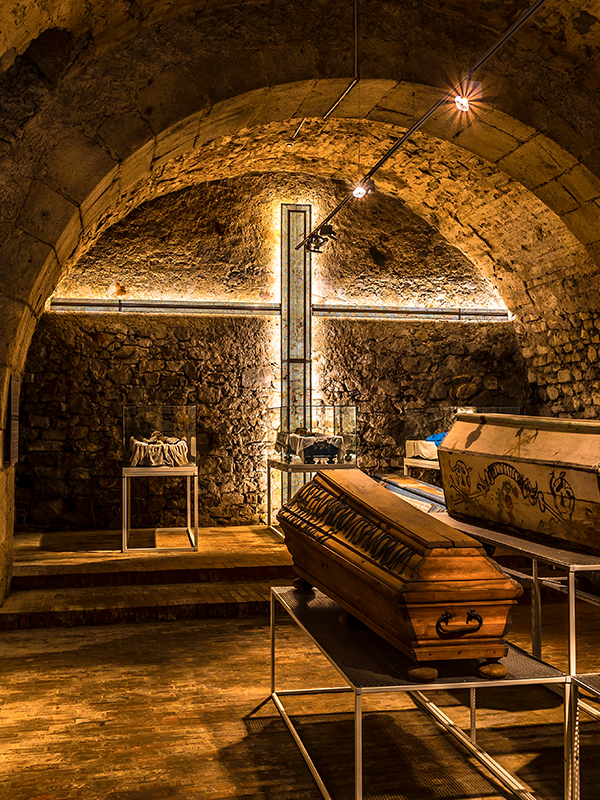
The exhibition space is an old medieval cellar. Descending the steep stairs into the cool and deep cellar, visitors are greeted by a list of names of the citizens of Vác, identified next to a picture of a contemporary crypt. The cistern to the left of the hatch displays the excavated sacral attachments (crucifixes, rosaries, medals). In the imposing main hall of the cellar, painted, colourful coffins of adults and children are displayed. The depictions of Christ and the symbols on display here also refer to the religious worldview of the people of the time and their relationship to death. At the back of the room, in a reconstructed glass coffin, lie the master tailor György Stefanovics, an unnamed middle-aged middle-class woman and a 9-year-old girl, Magdalena Solomon Magdalene, in a reconstructed costume based on the original. This gives visitors an insight into the funeral and burial customs of the late 18th and early 19th centuries.
The exhibition can be visited individually, but with a guided tour you can learn not only about the exhibition, but also about the period.

Photo by Zsuzsanna Dérné Lachegyi
Opening hours
From 3 November 2022 to 12 March 2023
from THURSDAY to SUNDAY from 10.00 to 17.00.
2600 Vác, Március 15. tér 19.